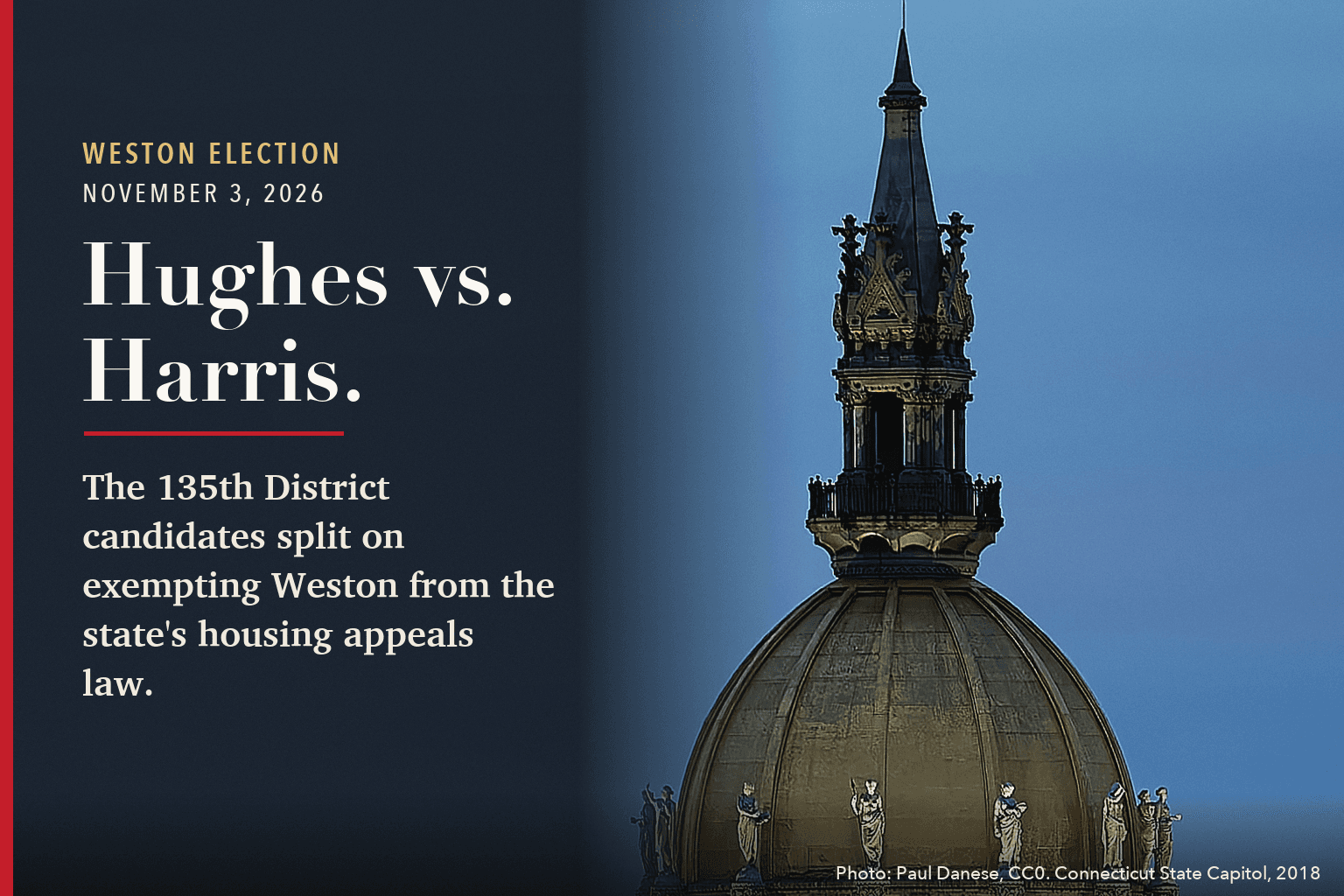
Weston's state representative says an exemption from the state's affordable housing appeals law for watershed towns like Weston won't pass until Connecticut makes progress on housing. Her Republican challenger says Weston and its neighbors can never meet that law's 10 percent mark and should get the exemption.
"I can introduce it but it won't pass," state Rep. Anne Hughes, a Democrat from Easton seeking a fifth term, said of an exemption at the candidates' Oct. 6 debate. Darrell Harris, also of Easton, answered: "I completely disagree with that premise." The two are on the Nov. 3 ballot in the 135th District, which includes Easton, Redding and Weston.
The law is 8-30g, the state's affordable housing appeals procedure. It lets developers of qualifying projects appeal local zoning denials in towns where less than 10 percent of homes count as affordable. The question put to both candidates noted that large parts of Easton, Redding and Weston sit on public drinking-water watersheds and rely on septic systems, and asked whether those towns should be exempt from 8-30g and from the housing targets in Public Act 25-1, the state housing law passed in 2025.
Hughes said she has tried to strengthen watershed protections, but that an exemption "will not pass until we have made as a state progress in creating more workforce housing," along with more middle and affordable housing across the region. She said she would like incentives for the region instead, such as counting a cluster of housing in one town, like Redding, toward the region's affordable housing, and help for the region to invest in sewers, septic systems and environmental protections.
Harris said Easton, Weston and Redding can never reach the 10 percent mark because there is not enough land, and said water companies own more than 70 percent of the land in Easton. He said the towns had made a bargain with the state to limit development that could harm the reservoirs, in return for carrying more of their own costs through property taxes, and that the area should get credit for that with an exemption.
A later audience question asked why legislators don't count existing accessory dwelling units in the watershed towns, smaller separate apartments on the same lot as a house, toward affordable housing. Hughes said she has worked on credits for existing accessory units and thinks one can pass next session. Harris said that in the meantime, short of an exemption, he would double what he described as a 25-year credit towns get for existing accessory dwelling units: "Extend the credit, double it, double it to 50 years."
The League of Women Voters of Redding and the League of Women Voters of Weston held the debate at the Mark Twain Library in Redding, and the library has posted the recording. Questions came from the audience, Zoom viewers and email, and were screened by one Democrat, one Republican and one unaffiliated voter, the organizers said.
Weston's middle school
One question was Weston's own. It cited a $126 million estimate for a new middle school and asked what each candidate would do to get more state money for it. Connecticut pays back part of the cost of approved school projects. The Board of Finance chair has put the rate for building new at about 11 percent; the board's tax model assumes 22.14 percent, a rate its slides say would take an act of the legislature, as we reported.
Hughes said she had pitched the governor, who she noted chairs the State Bond Commission, a 40 percent reimbursement rate on the first couple of million dollars of school projects built with prevailing wages, the union-scale pay rates set by the state. Weston's rate is low, she said, because the formula rests largely on a town's grand list, the value of its taxable property; the state ranks towns by that wealth per resident. "We have aging buildings across the state and no town can afford to replace it outright," she said. "So we need the state investment."
Harris said towns like Weston send far more to Hartford in taxes than they get back. Left alone, he said, the rate would be about 11.5 percent, and "if we beg," about 22.5 percent. "That's not fair," he said. He said he would "forcefully advocate for us getting our fair share."
Taxes and special education
Asked about raising taxes, Harris said taxes are necessary but that he would want to see state money spent efficiently first. "I want taxation to be fair but I don't want taxation to be confiscatory," he said.
Hughes pointed to the federal law known as H.R. 1, which she said is costing Connecticut $2 billion in federal money this year. "We can't afford to increase our state taxes to fill those holes," she said, adding that she has worked on tax relief for older residents and some veterans.
Both said the state should carry more of the cost of special education. "If the state is gonna mandate something like that, the state should fund it," Harris said. Hughes said special education costs are the next big problem the legislature has to solve, and that they should not fall entirely on towns or entirely on the state.
Asked for their top three priorities for the district's finances, Harris named local control, carve-outs from 8-30g, and rebuilding Bridgeport's economy, which he said would ease the region's finances more than anything else. Hughes named affordable health care, returning more special education money to towns for property tax relief, and "a 40% reimbursement rate on the school construction."
Electric bills
Hughes said she joined the legislature's Energy and Technology Committee to study the utilities. She said lawmakers passed reforms, including one that bars utilities from charging customers for their lobbyists, and that she wants more investment in solar and wind. Harris said the legislature could remove the public benefits charge, a line on electric bills that he said was added to help people during COVID. He said fossil fuels will be the cheapest energy for the foreseeable future.
The candidates
Hughes is a licensed master social worker in her fourth term, according to her House Democrats biography. She serves on the Aging, Energy and Technology, Human Services, and Labor and Public Employees committees, and co-chairs the House Progressive Democratic Caucus. She is an assistant majority whip, according to the House Democrats' leadership roster.
At the debate, Harris said he worked his way out of the housing projects in the Bronx, went to the Bronx High School of Science and Yale, and worked on Wall Street, ending his career there at Goldman Sachs. He said he has his own business and served for a time as interim executive director of a behavioral health facility in Shelton.
In closing, Harris said he respected Hughes's service, "but frankly after eight years of issues with affordability, zoning and local control that have not been resolved it's time for a change." Hughes said, "I want to be your partner for another two years."
The money
Both qualified for public financing through the Citizens' Election Program, the state's voluntary system that gives grants to legislative candidates who raise enough small donations and stop fundraising. The State Elections Enforcement Commission found Hughes eligible on Aug. 12 and Harris on Sept. 30.
Through Oct. 20, Hughes's committee had reported spending about $25,500 and had about $20,400 left; Harris's had reported spending about $12,700 and had about $20,600 left, according to the commission's filing records.
How to vote
Early voting runs through Sunday, Nov. 1, in the Town Hall Meeting Room, 56 Norfield Road: 8 a.m. to 8 p.m. on Thursday, Oct. 29, and 10 a.m. to 6 p.m. on other days. Voters can register the same day during early voting hours. On Election Day, Tuesday, Nov. 3, polls are open 6 a.m. to 8 p.m. in the Weston Middle School gym; the entrance is at the back of the school, according to the Registrar of Voters.
The rest of Weston's ballot, including the 26th District state Senate race and the three charter questions, is in our ballot story.