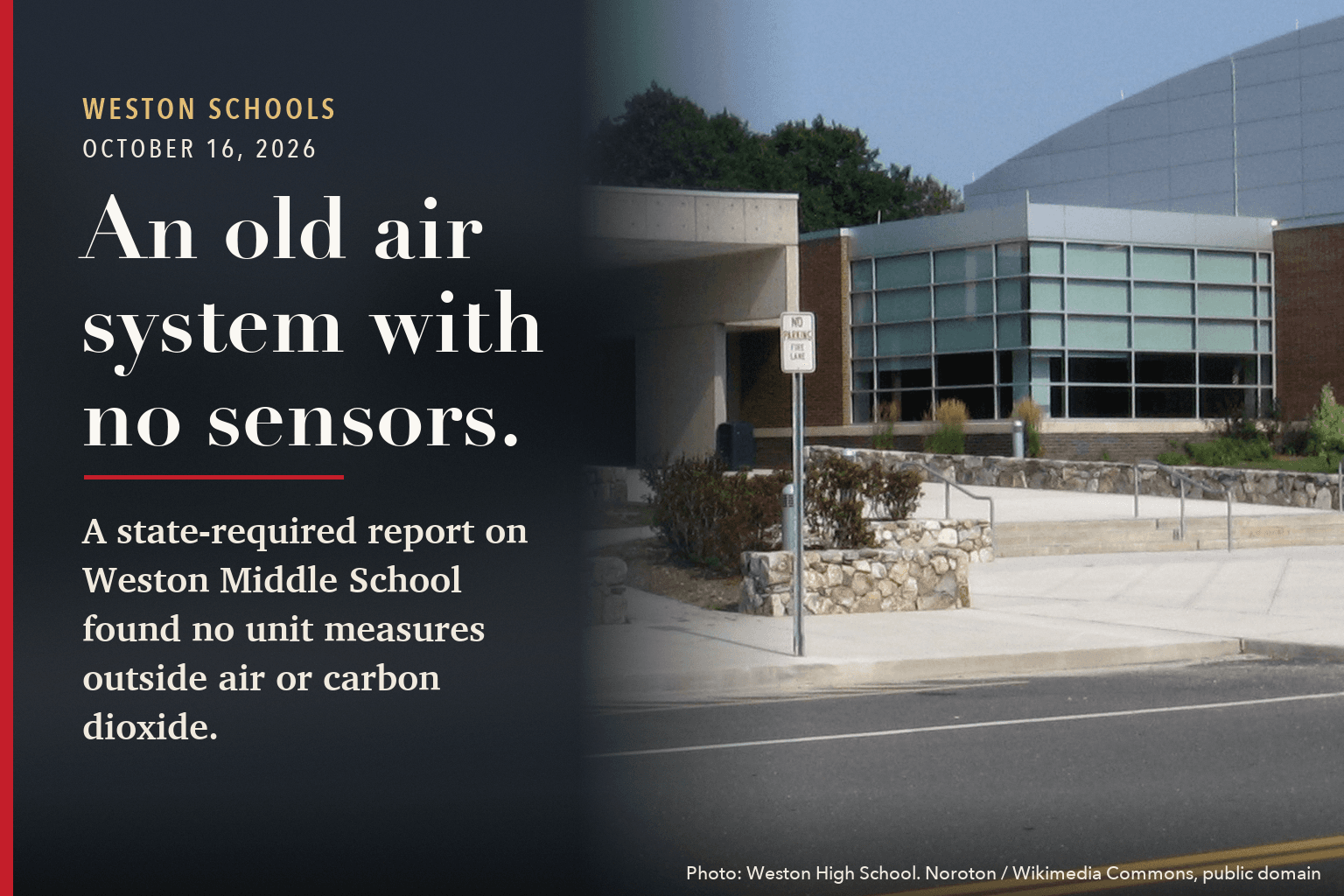
No system at Weston Middle School tracks, day to day, whether the building is getting enough fresh air, a state-required inspection has found. On Friday, Oct. 16, Board of Education Chair Deborah Low urged the district to start fixing that.
The report, by the firm Pennoni, was done under state indoor air quality rules after an inspection Aug. 12. Its findings:
- The classroom units bring in outside air only when they are running, and they are switched on and off by hand.
- One of the five main air handlers has an outside air damper, the flap that lets fresh air in, that is stuck and must be set by hand.
- Even with the main air handlers' dampers wide open, readings suggested only 30% to 70% of the air was coming from outside.
- The F-wing ventilation unit wasn't running, and its fan was in alarm. The H-wing unit isn't monitored by the building's control system.
- No unit measures outside airflow or carbon dioxide, a common stand-in for whether a room is getting enough fresh air.
The equipment is original to the middle school and past its expected life, the report says. The town has not decided whether to build a new middle school. Its three boards are working toward a townwide vote in November 2027.
"This school is probably the one that's farthest behind in terms of modernizing controls," a Pennoni HVAC specialist told the Board of Education's finance and facilities committee. His two top priorities: carbon dioxide sensors, and bringing in a balancer to readjust the five main air handlers so the school gets the outside air it should.
The district tests the air every year for the state, Facilities Director Michael DelMastro said, and "we haven't seen anything extremely elevated." The building needs more routine maintenance than the others, he said, and it gets it. "The guys do a great job with that building," he said.
The Pennoni specialist had praised the upkeep. "Good for you for keeping these going so long," he said, and he called what the crew goes through to reach the air filters above the boiler room "harrowing."
Low asked the district to get the sensors in and bring a balancer in. "If it's extra cost, it's extra cost," she said. "We've got to have an eye and a reporting system for the indoor air quality of this building. On a regular basis, not once a year."
DelMastro said he would call the company that runs the school's building control system after the meeting about adding sensors, and would get a proposal for the balancing.
A second Pennoni consultant cautioned that once sensors go in, they will likely show high carbon dioxide when students fill the rooms, because the system can't bring in more air as a room fills. In his view, he said, the school "is not an outlier compared to most Connecticut public schools."
Chief Finance and Operations Officer Phillip Cross said the district is about to request proposals for a new facilities assessment, which will include a plan for the middle school's heating and ventilation system.