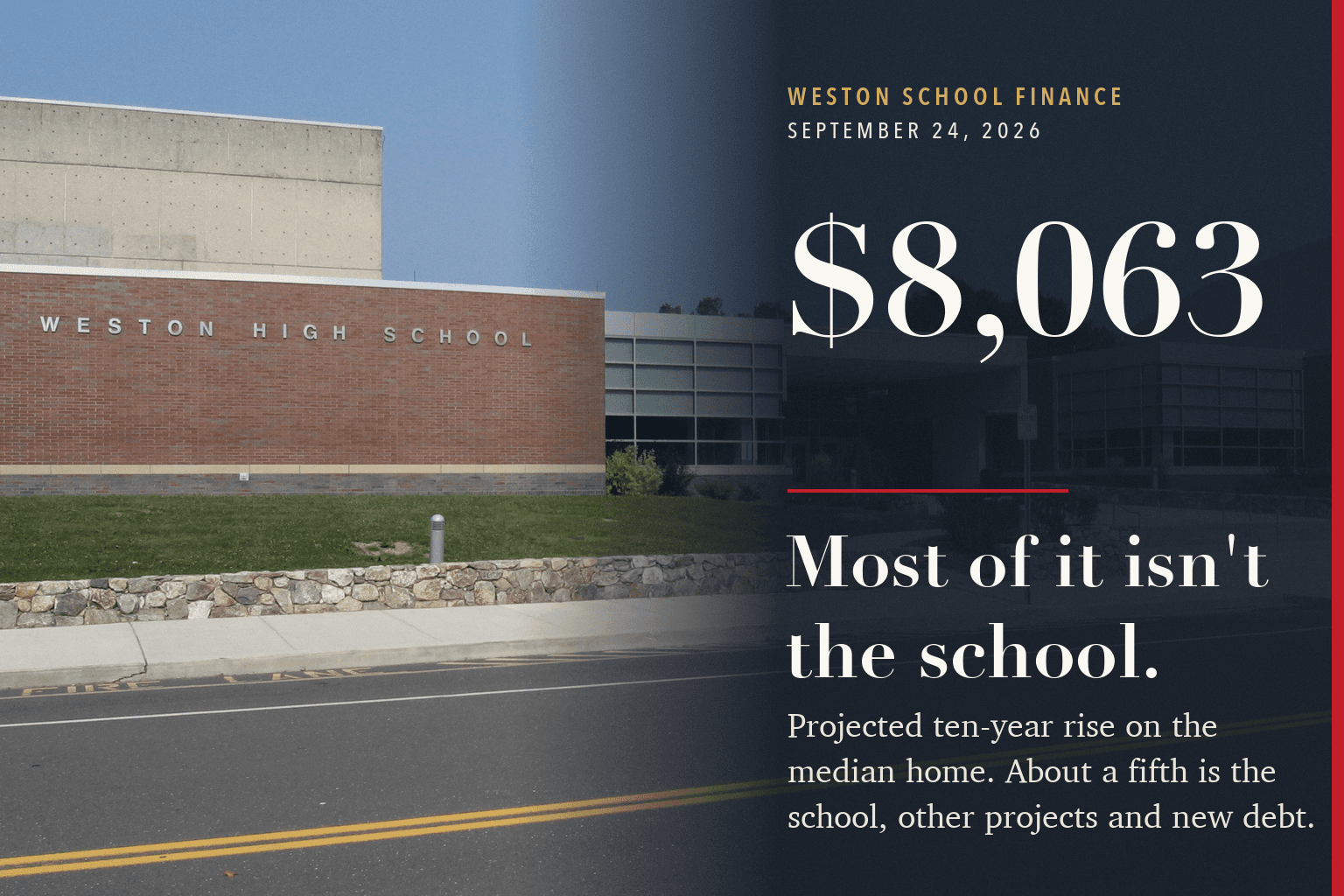
The tax bill on a median Weston home would rise by about $8,000 over the next ten years, according to a projection from Board of Finance Chair Michael Imber that assumes the town builds a new middle school. About a fifth of that increase comes from the new school, the town's other capital projects and new borrowing combined. The rest comes from the model's assumption that town and school budgets keep growing.
Imber put it more simply. "The new school is only contributing about 21% of the growth," he told a joint meeting of the Board of Selectmen, Board of Education and Board of Finance on September 24.
The model also shows the problem with the obvious fix. Slowing the budgets brings the tax bill down, and pushes debt payments slightly past the Board of Finance's 10 percent guideline.
The base case
Imber's model starts the median home at $16,906 in taxes in 2027 and ends at $24,969 in 2036, an increase of $8,063. The mill rate, the tax charged for every $1,000 of assessed value, climbs from 24.94 to 33.41 over the same decade.
His slides attribute 21.2 percent of the increase to the new middle school, the other capital projects and new debt payments, and 79.8 percent to operating budget growth. Those two shares add to 101 percent rather than 100.
Imber opened with a warning about all of it. The analysis had not gone to the board's debt service capacity subcommittee or the full Board of Finance, as his last presentation had.
"Everybody's seeing this now for the very first time," he said. "If there are any mistakes in here, they are mine and mine alone."
His opening slide carries his standing caveat: the scenarios are hypothetical, they depend on the assumptions put into them, and any future bond issue needs the approval of Weston voters.
Build new or renovate, nearly the same bill
At the boards' June 17 joint meeting, Imber's analysis compared a $128 million new middle school with a $100 million lighter renovation of the existing building. Under the model's assumptions, each left the median home paying about $8,000 more by 2036.
"So the choices were a coin toss," Imber said. "They were roughly equivalent under the assumptions."
The September version turned to the assumption doing most of the work: how fast budgets grow.
The growth rate is the bigger lever
The original base case grows the town's operating budget 4.6 percent a year and the school district's 3.75 percent. Imber's slides compare those against Weston's own history. Over the last 20 years, the town averaged 2.7 percent and the schools 2.1 percent. Over 10 years, 3.1 and 2.4. Over five, 3.4 and 2.2.
He ran two alternatives, both using updated interest rates:
- At growth halfway down to the 20-year averages, the median home's ten-year increase falls to $6,732 and the mill rate to 31.63.
- At the 20-year averages themselves, it falls to $5,305 and 29.72.
In those cases the share of the increase from the school, other capital projects and new debt rises, to 27.4 percent and 34.1 percent.
"If we're going to afford a new school, we can't have operating growth rates that run five, 6%," Imber said. He called that the point "the community should hold the Board of Selectmen, the Board of Finance, and the Board of Education accountable for."
Board of Education Vice Chair David Felton pushed back on using past growth as the yardstick. The school board's budgets, he said, start higher and are cut to a level the community will accept before they are submitted.
"It's never 3%," Felton said. "Quite frankly, it's usually in the 5% range." The district, he said, has "operated with an unsustainably low ask every year."
The catch in the slower-growth cases
Slower budget growth lowers the tax bill. It also makes the borrowing look heavier. As Imber explained it, the debt payments are measured against a budget that is growing more slowly.
The Board of Finance keeps debt payments at or below 10 percent of the net budget. "That is not law," Imber said. "That's not a town ordinance. That's just a policy of the Board of Finance."
In the original base case, debt payments reach 10 percent in 2031 and settle to 9.1 percent by 2036. In both slower-growth cases they go over the line, by what the slides call a marginal amount: 10.9 and 11.1 percent in 2031, and 10.3 and 10.9 percent in 2036. Both leave the town with no room to borrow more under that policy in either of those years, according to the slides.
Interest rates moved against the town
Since the June model, rates on AAA-rated municipal bonds, the benchmark Imber used to price the borrowing, have risen an average of 0.749 percentage points, his slides say. Applied to the base case, that raises average annual debt payments by about $1.5 million, or 16 percent, on 20-year bonds, and by $594,000, or 6.7 percent, on 30-year bonds.
Twenty years or thirty
The model assumes the town borrows over 30 years and that the state reimburses 22.14 percent of the construction cost. The slides note that rate "will require an act of the Connecticut General Assembly." Imber said the June presentation also showed the build-new rate, which he put at about 11 percent.
Board of Education member Michael Guido said the town's starting point should be the lower rate. "The reimbursement rate for the build as new was closer to 10%, right? Not 22," he said, adding that the 22 percent "was for the renovate as new." He suggested the base case use a 10 percent reimbursement and 20-year bonds. Imber said an exception to reach 22 percent is common when renovating would cost about the same as building new, but that it would have to be approved by the legislature.
Answering Guido, Imber said he favors 30 years, and was careful about whose view that was. "This is my opinion, not necessarily the Board of Finance's," he said. His reason was what he called intergenerational equity. "When you finance something this big for the town over 20 years, you basically have a generation and a half of school children's parents paying for it," he said.
Selectwoman Lauren Traum also questioned the 30-year term. She said it looked to her as if nearby towns with top credit ratings, which she named as Westport, Fairfield and Darien, use 20-year debt for school construction.
"I worry about the systems within the school that likely will need to be replaced within that 30 year," she said.
Traum asked how much more interest a 30-year term would cost than a 20-year one. "I don't have that answer, but I'll get it for you and I'll email it out," Imber said.
What comes next
The boards took no action on the analysis; their only votes were to approve the June 17 minutes and to adjourn. Imber said the analysis will go to the debt service capacity subcommittee and the Board of Finance for review. The Board of Finance's next regular meeting is October 8. The boards' draft schedule for the project points to a townwide vote on November 2, 2027.