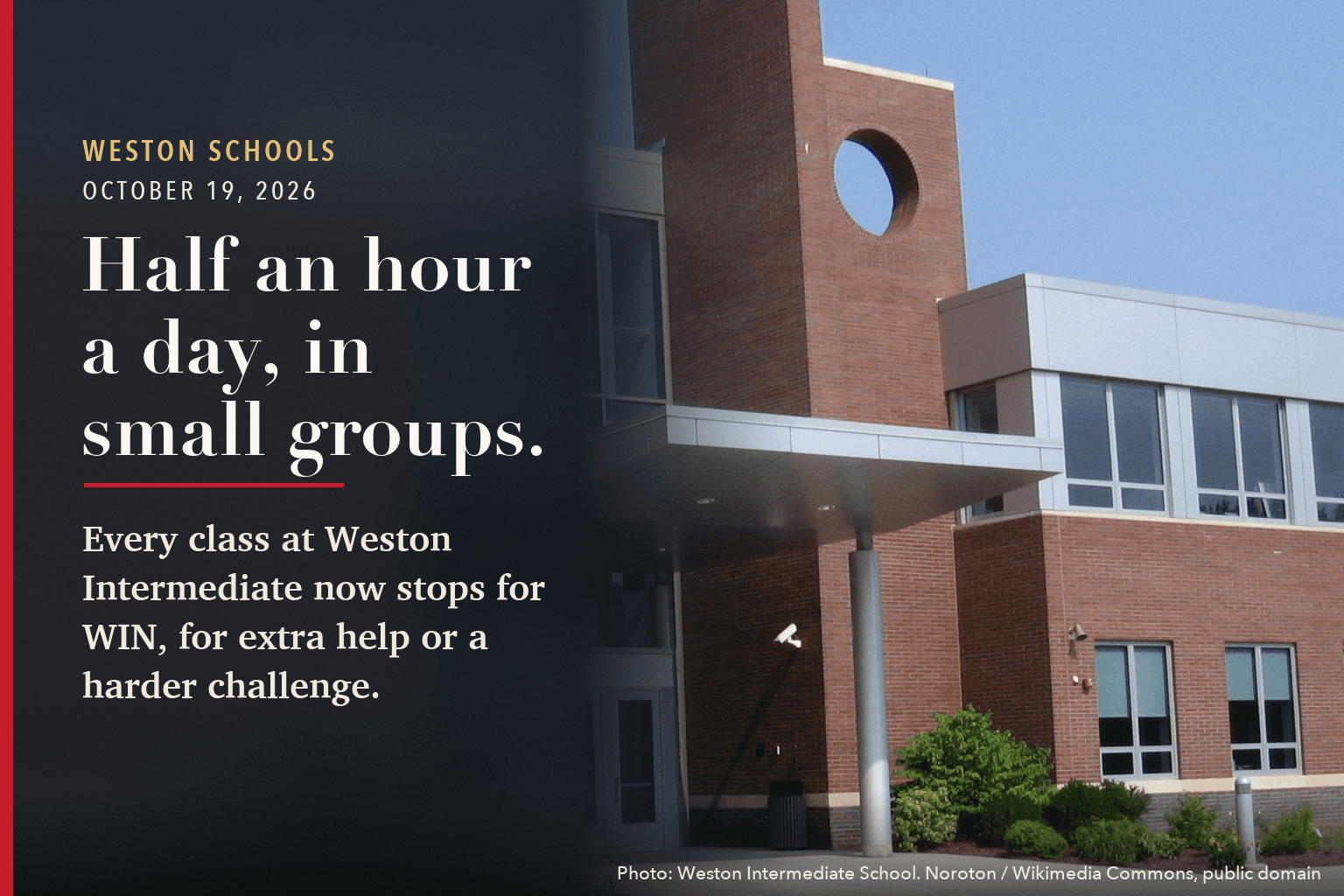
Every day, every class at Weston Intermediate School, the town's public school for grades 3 through 5, now stops for 30 minutes so teachers can work with children in small groups. The school calls it WIN. A child might get extra help in one group, harder work in another, or spend the half hour working on their own while the teacher meets with classmates.
The block is meant for children at both ends. Principal Jennifer D'Amico told the Board of Education on Monday, Oct. 19, that parents had told her about children who were strong in math and wanted more challenge, and about children who didn't receive intervention services, the school's targeted extra help, but needed "a little extra push." "It's not just about supporting students who might not be making benchmark," she said. "It's also making sure those students who are really excelling have spaces where they can continue to excel and continue to grow."
The block had been running "five whole weeks," D'Amico said, and she was giving the board an early look. The presentation was for discussion, and the board took no vote.
A small group "just means maybe six or less," D'Amico said, and the teacher decides how many. It can be one child. In a typical block, a teacher might meet two groups of about 10 minutes each, with five minutes in between to write notes. D'Amico has encouraged teachers to plan in 10-day stretches, so they can see every student in a small group within that time.
For the rest of the class, "this time isn't core instruction," D'Amico said. Children might finish work, do an independent project, work on fluency practice, play games, take on challenging math tasks, or, on some days, all read for the full half hour while the teacher pulls groups. Advanced readers can meet in book clubs. The district this year moved third through eighth graders to shared classroom Chromebooks, and D'Amico said games and book clubs are among the options in place of practicing on a computer.
Children who leave class for services are pulled out during WIN where possible, so they don't miss other lessons. "They're certainly not missing out on core instruction," D'Amico said, though not every pull-out can be moved there.
To find the half hour, the school kept its morning meeting, cut slack from the time between activities and reworked the schedule for specials, the classes children take outside their homeroom. "Our teachers are actually feeling it," D'Amico said. "It's tightened up a little bit." The school laid out the week so there is still enough time to meet the state's requirements for instructional minutes, she said, and a teacher who has less writing time on a given day can use that day's WIN block for writing. She called the reworked specials schedule "not perfect" and said she hopes to adjust it.
D'Amico said the school's growth data, which it has watched for a while, show children in intervention growing. The gap is at the other end. "Our students who are meeting benchmark or exceeding benchmark don't grow as much. And they should be," she said. To judge the block, she will look for growth among those students, rising achievement numbers, and how well teachers work together and use data.
Teachers are still working out how to plan for the groups. "I don't want to say overwhelmed, but I think they're unsure," D'Amico said. "We're in that messy part where we're learning what that planning looks like."
Board member Nicole Wallach said she had already heard from one parent at the school "touting how pleased she is." "The only shame right now is that it's only in WIS," Wallach said. She said she hoped the school could share results by the end of the year and that the block could be expanded beyond grades 3 through 5.